R&A Electronics Market Watch | July 2026
Mature-Node Capacity Tightness Returns to the Market
8-inch foundry utilization, selective price increases, and power-related demand are bringing PMICs, power discretes, analog ICs, and protection devices back into procurement focus.
Semiconductor Supply Chain Update | July 2026
Key Takeaway
Mature-node components are moving back into supply-chain focus. This is not a broad shortage across every product category, but 8-inch capacity pressure, selective foundry price increases, and stronger demand for power-related components are making PMICs, power discretes, analog ICs, and protection devices more important to monitor.
For much of the past cycle, mature-node components were often viewed as lower-risk compared with advanced logic, HBM, and other AI-related semiconductor categories. That view may need to be updated.
Recent foundry signals suggest that mature-node capacity is tightening again in selected areas, especially where products remain dependent on 8-inch wafer platforms. The issue is not that every mature-node component is suddenly in shortage. The more practical concern is that utilization, pricing, and capacity allocation are becoming less relaxed than before.
For procurement teams, this matters because mature-node components are deeply embedded in industrial systems, automotive electronics, networking equipment, power supplies, medical devices, consumer electronics, and long-lifecycle platforms. When these parts tighten, replacement is often not simple because qualification, approved vendor lists, and product lifecycle requirements can limit flexibility.
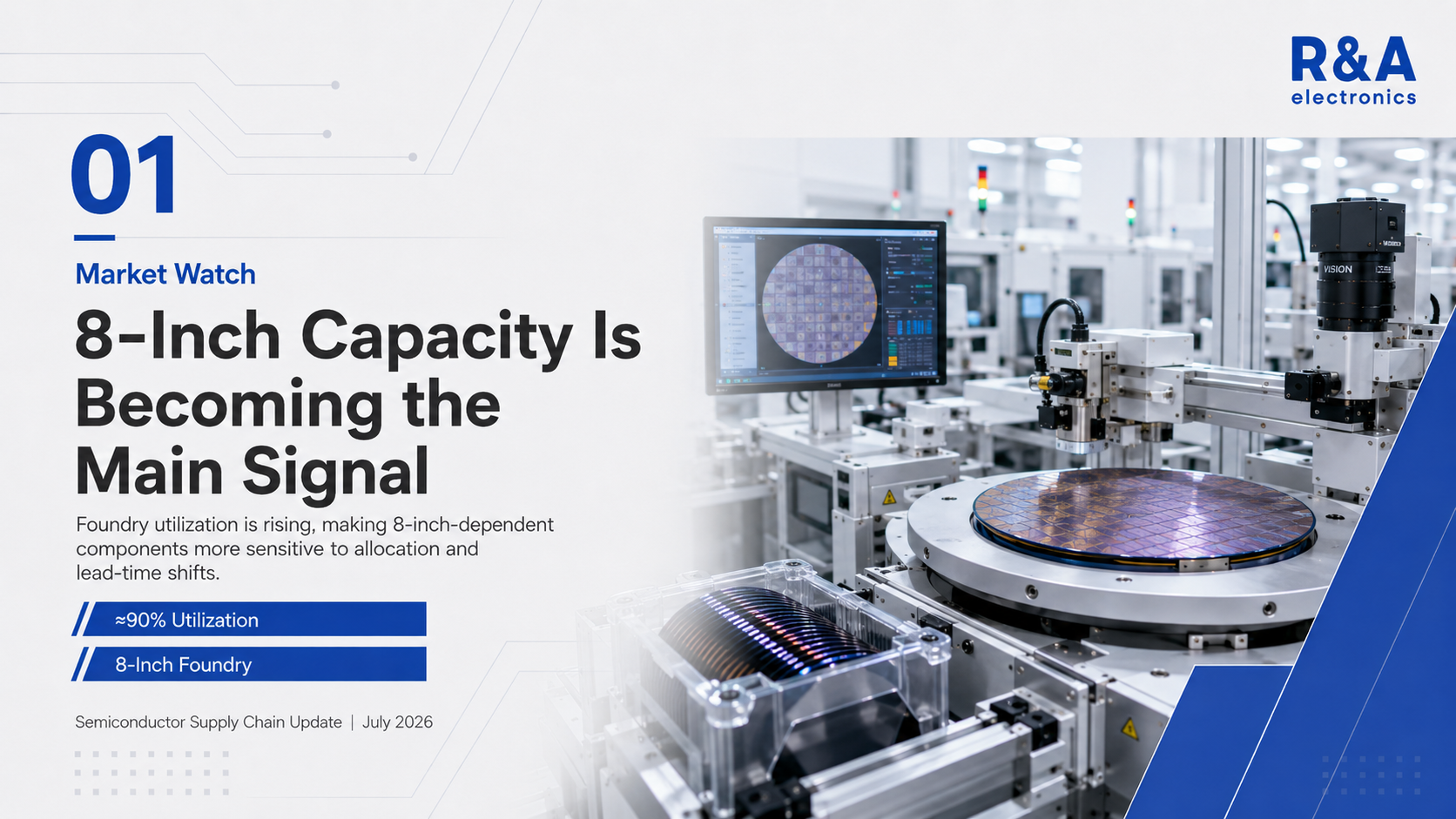
One of the clearest signals is 8-inch foundry utilization. TrendForce has indicated that the average 8-inch utilization rate among the world’s top foundries is approaching 90% in 2026, compared with around 80% in 2025.
This is important because many everyday semiconductor components still rely heavily on 8-inch manufacturing. PMICs, power discretes, analog ICs, protection devices, gate drivers, and some high-voltage or specialty products are often linked to mature or specialty processes rather than leading-edge nodes.
When utilization moves higher, procurement risk can change quickly. Suppliers may become more selective on order acceptance, price validity may shorten, and lead times may become more sensitive to forecast accuracy.
~90%
Average 8-inch utilization among top global foundries is moving close to 90% in 2026.
5–15%
Selected mature-node foundry pricing has seen average increases across 1Q–2Q26.
2027
Pricing and utilization pressure may extend into 2027 for selected mature-node processes.
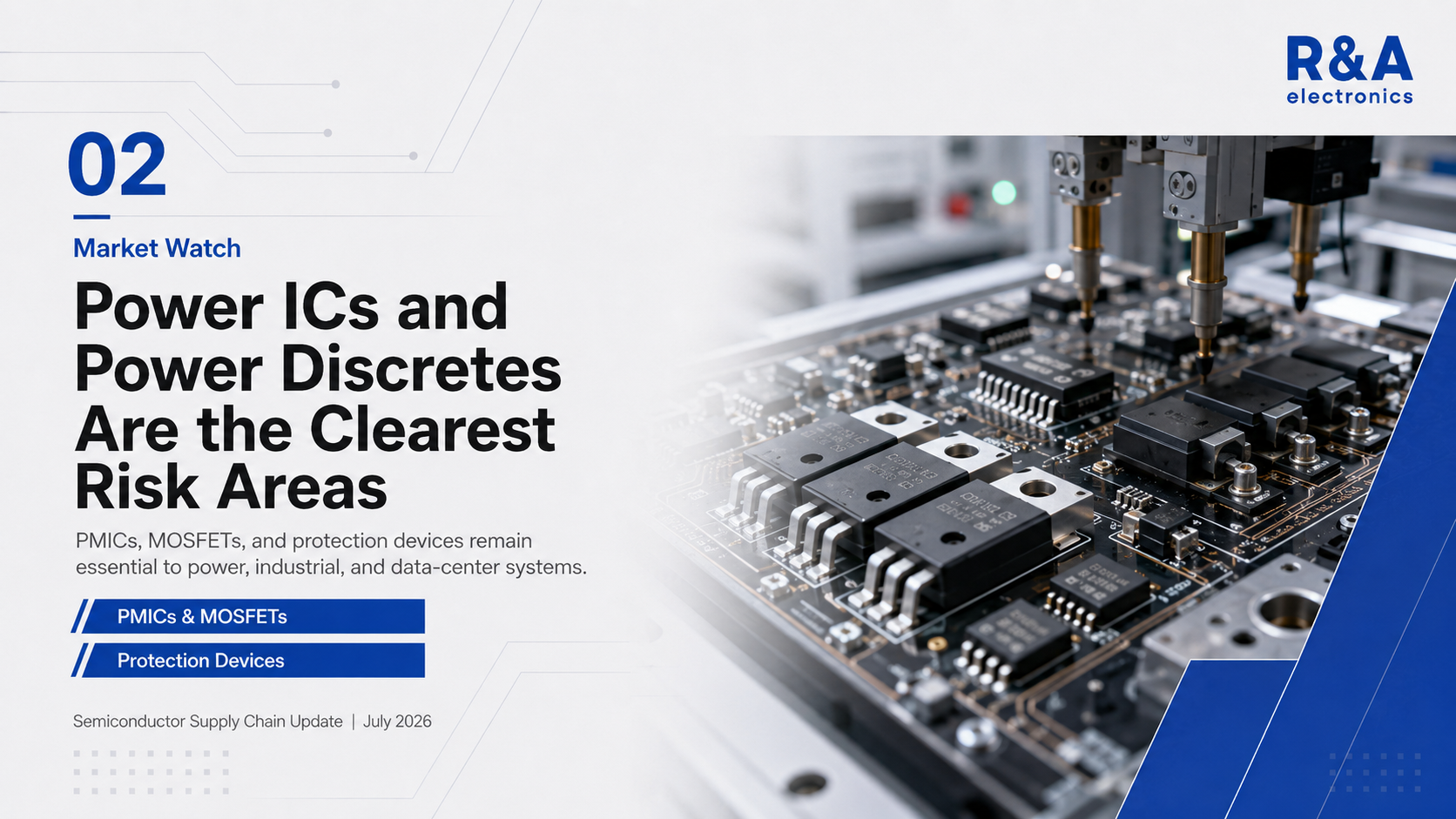
Power-related components are becoming one of the clearest areas to watch. Demand for PMICs, MOSFETs, power discretes, gate drivers, voltage regulators, protection devices, and related analog products is supported by data center infrastructure, industrial automation, automotive electronics, power supplies, networking systems, and energy-related applications.
Many of these components are not leading-edge chips, but they are essential to system operation. A missing PMIC, MOSFET, driver, or protection device can delay production just as seriously as a missing processor or memory device.
The risk is also different from advanced-node shortages. Mature-node parts often have long qualification histories and strict approval requirements. For automotive, industrial, medical, and networking applications, changing suppliers or package versions may require engineering review, customer approval, and testing.

Another important signal is capacity reallocation. As foundries respond to different margin profiles and changing demand patterns, some capacity is being directed toward PMIC, BCD, power discrete, interposer, photonics-related, and other higher-value applications.
This can reduce flexibility for lower-margin or less prioritized product lines such as some display driver ICs, image sensors, or standard mature-node products. The result may not be a uniform shortage, but it can create uneven availability across product families, foundry origins, package types, and end applications.
For buyers, the practical question is not only whether a category is broadly tight. It is whether the specific process, supplier, package, grade, and approved manufacturing route behind a component are becoming tighter.
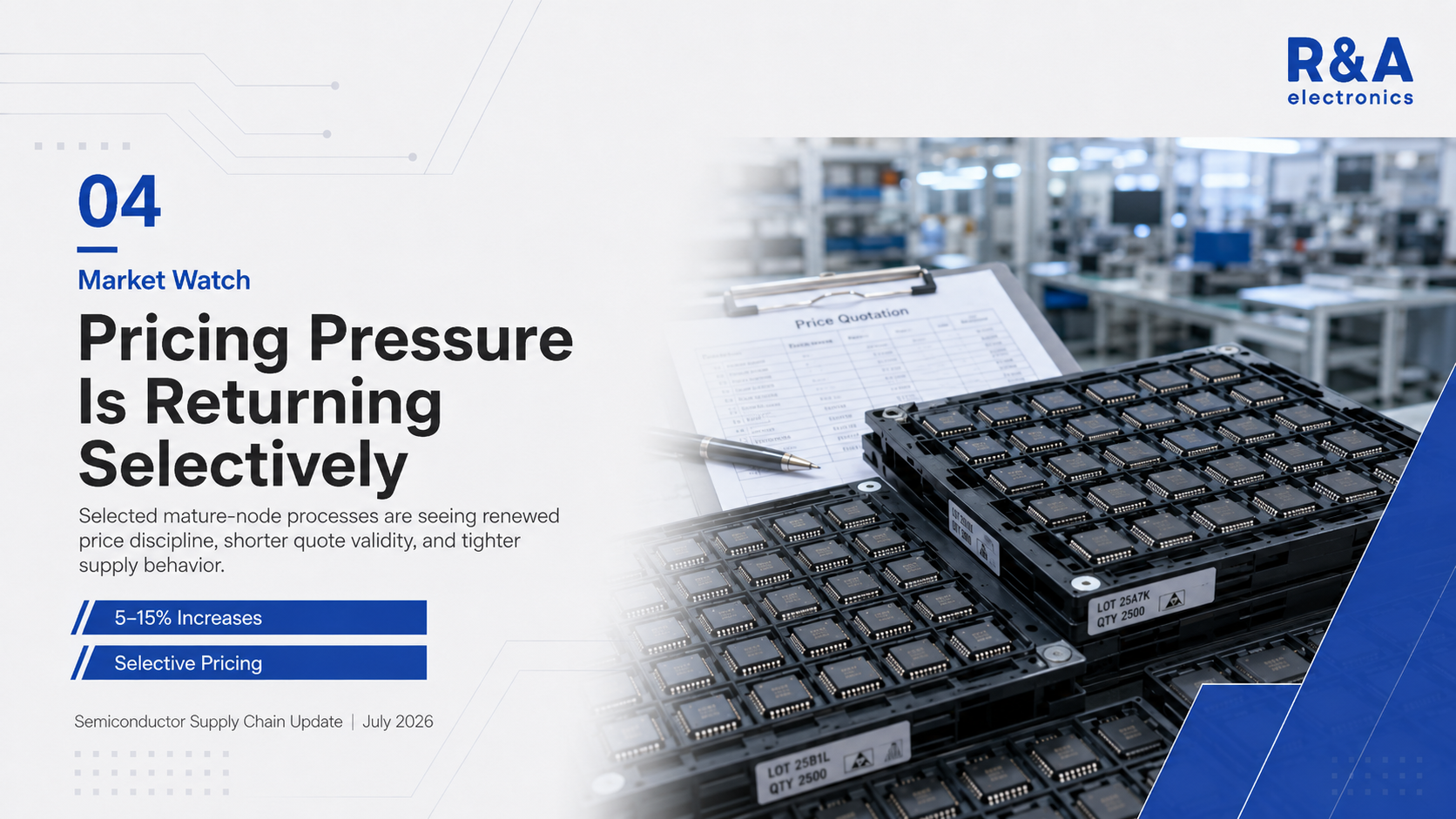
Foundry pricing is also moving back into focus. Market reports indicate that mature-node foundry pricing for selected processes has already seen increases in 2026, with average increases in the 5–15% range across certain areas.
This does not mean all mature-node components will rise at the same pace. End-market visibility remains uneven, and some standard products may still be available at stable prices. However, products linked to tighter 8-inch platforms, higher-margin power applications, or constrained supplier capacity may become more exposed to price adjustment and allocation behavior.
For procurement teams, the focus should shift from simple price comparison to supply assurance. Shorter quote validity, changing MOQ requirements, longer lead times, and reduced spot availability may all appear before a full shortage becomes visible.
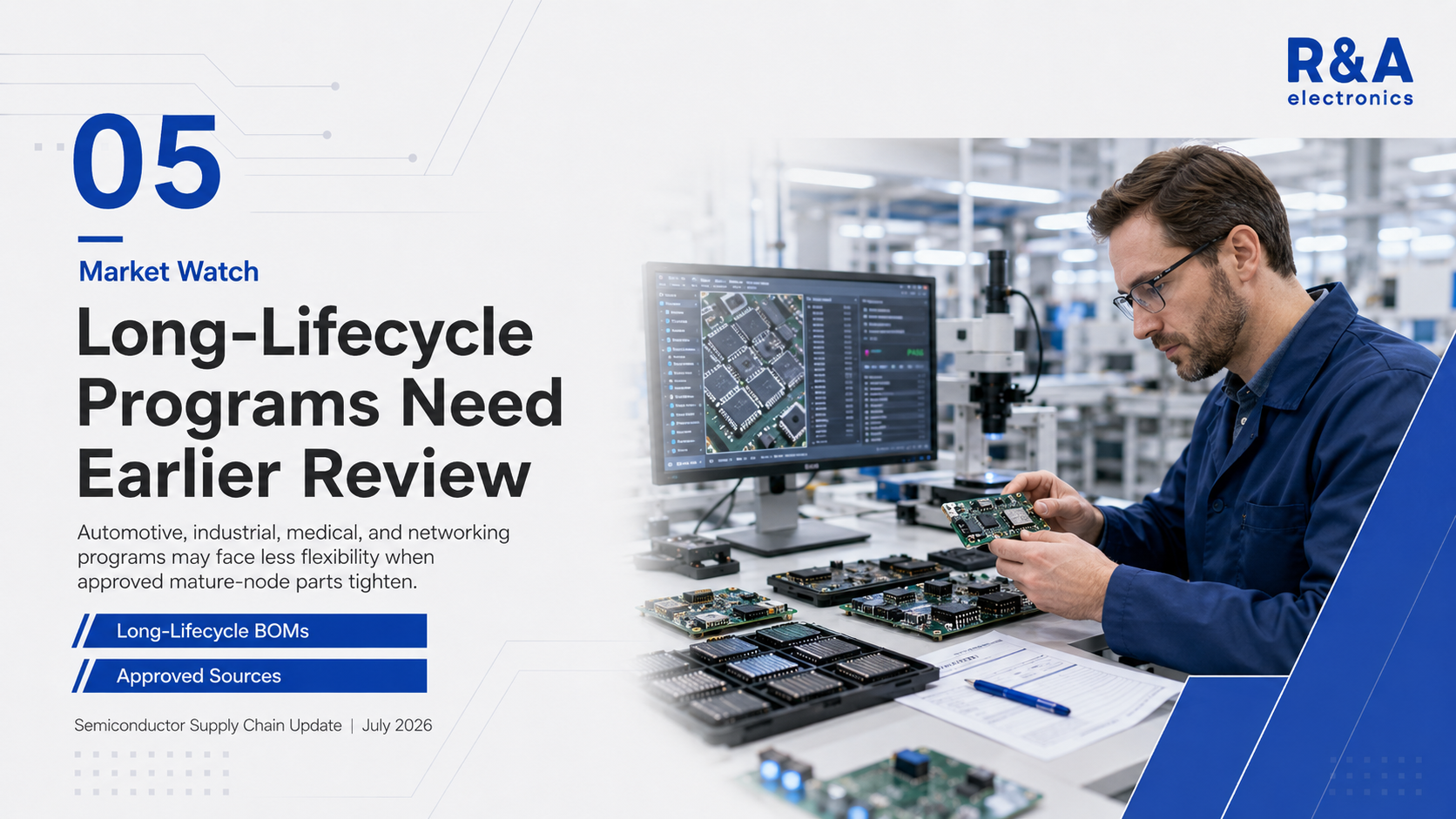
The return of mature-node tightness is especially relevant for long-lifecycle programs. Automotive electronics, industrial control, medical devices, aerospace, energy systems, and networking equipment often rely on approved components that remain in production for many years.
These programs may not be able to switch suppliers quickly when lead times extend or pricing changes. Alternative parts may require validation, firmware review, thermal checks, qualification testing, and customer approval.
That makes early visibility important. Procurement teams should review critical mature-node parts before pressure becomes more visible in the spot market.
What This Means for Procurement Teams
Procurement teams should not assume that mature-node components are automatically low-risk. The market is becoming more selective, and risk may appear by process, supplier, package, specification, and application.
Procurement teams should monitor:
- Lead-time changes by supplier and package
- Foundry-linked allocation behavior
- Quote validity and price revision cycles
- MOQ and forecast submission requirements
- Approved alternative status
- Single-source or single-origin exposure
- Long-lifecycle BOM risk
Categories to review:
- Power ICs: PMICs, voltage regulators, LDOs, DC-DC converters
- Power discretes: MOSFETs, rectifiers, TVS, protection devices
- Analog ICs: amplifiers, interface ICs, sensors, monitoring ICs
- Control devices: MCUs, gate drivers, hot-swap controllers, eFuses
- Long-lifecycle applications: automotive, industrial, medical, networking, energy systems
R&A View
Mature-node tightness should be viewed as a selective supply-chain risk, not a broad shortage across every component. The most important areas to watch are 8-inch-dependent products, power-related components, analog ICs, protection devices, and long-lifecycle parts with limited approved alternatives.
For procurement teams, the key question is no longer only whether a part is available today. It is whether the same part can be secured at stable pricing and lead time through the next planning cycle.
A practical approach is to review mature-node exposure across the BOM, identify single-source risks, validate alternatives early, and monitor supplier behavior before spot-market pressure becomes more visible.
R&A Electronics will continue to monitor pricing, lead-time, and allocation signals across mature-node semiconductor categories to support more informed sourcing decisions.
Procurement teams should not only ask: "Is this a mature-node part?" They should also ask: "Is the process, supplier, and approved source still secure?"
Frequently Asked Questions
Does this mean all mature-node components are in shortage?
No. The risk is selective. Pressure is more likely to appear in 8-inch-dependent products, power-related components, specific analog ICs, and long-lifecycle parts with limited approved alternatives.
Which components should buyers review first?
PMICs, MOSFETs, voltage regulators, gate drivers, protection devices, analog ICs, hot-swap controllers, eFuses, and long-lifecycle industrial or automotive components deserve closer review.
Why does 8-inch capacity matter?
Many power, analog, protection, and specialty semiconductor products still rely on 8-inch manufacturing. When utilization rises, suppliers may become more selective on capacity allocation, pricing, and order acceptance.
Is this the same as the 2020–2021 shortage cycle?
Not exactly. The current signal appears more selective and process-specific. It is driven by utilization recovery, capacity reallocation, pricing discipline, and demand strength in selected power and mature-node categories.
What should procurement teams do now?
Review mature-node exposure across the BOM, confirm supplier lead times, check price validity, identify single-source risks, validate alternatives, and monitor long-lifecycle programs that rely on approved power, analog, and protection components.
Need support with semiconductor sourcing?
R&A Electronics helps procurement teams monitor mature-node supply movement, review sourcing options, and respond faster to changing semiconductor market conditions.
Contact R&A